
Introduction
Battery manufacturing has changed significantly as demand for electric vehicles, energy storage systems, power tools, and portable electronic devices grows. Manufacturers need reliable welding equipment to connect battery cells, metal tabs, terminals, and conductive strips. Choosing the right machine can directly affect production efficiency, weld consistency, and operating costs.
Two options worth considering are an automatic battery tab welder and a manual laser welder. Both can join metal components, but they serve different production needs.
An automatic battery tab welder focuses on repeatable welding operations. Depending on its design, it may use resistance welding, laser welding, or another joining technology. A manual laser welder gives operators more direct control over the welding process and can handle a broader range of metal fabrication tasks.
So, which machine should you choose?
The answer depends on your materials, production volume, required weld quality, budget, and the type of products you manufacture.
In this guide, we’ll compare both machines in detail, explain their advantages and limitations, and help you choose the solution that fits your workshop or manufacturing facility.
1. What Is an Automatic Battery Tab Welder?
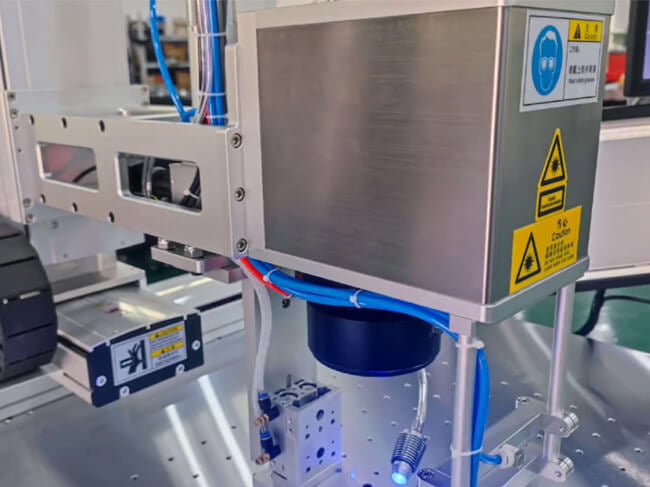
An automatic battery tab welder is a specialized machine that joins battery tabs, metal strips, terminals, or related components with minimal manual intervention.
Battery tabs provide electrical connections between cells and other components in a battery pack. These connections must withstand mechanical stress while maintaining reliable electrical conductivity.
A suitable welding system creates a joint that meets the battery’s electrical, mechanical, and dimensional requirements.
Depending on the application, automatic battery tab welding equipment may use several technologies:
- Resistance spot welding: Uses electrical current and pressure to generate heat at the joint.
- Laser welding: Uses a focused laser beam to fuse metal components.
- Ultrasonic welding: Uses high-frequency mechanical vibrations to create a solid-state bond.
- Automated welding systems: Combine a welding process with fixtures, positioning mechanisms, sensors, or robotic handling.
These technologies aren’t interchangeable in every application. Material combinations, tab thickness, joint geometry, and battery design determine which method works best.
How Does an Automatic Battery Tab Welder Work?
Although the exact process varies by machine, a typical automatic system follows several steps.
Step 1: Load the components
The operator or an automated handling system places the battery components in the designated fixture.
Step 2: Position the welding area
The machine aligns the tab and terminal. Advanced systems may use cameras, sensors, or programmed positioning to improve accuracy.
Step 3: Apply the welding process
The equipment activates the selected welding technology according to predefined parameters.
Step 4: Complete the weld
The machine finishes the programmed weld points or sequence.
Step 5: Inspect the connection
The operator or an integrated monitoring system checks the weld against established quality requirements.
Automation can improve repeatability, especially when the machine uses stable fixtures and validated welding parameters.
However, automatic operation doesn’t automatically guarantee a perfect weld. Material preparation, component positioning, process settings, and quality control remain essential.
Typical Applications
Automatic battery tab welders are commonly considered for:
- Lithium-ion battery pack assembly.
- Nickel strip welding for battery connections.
- Battery terminal and collector plate joining.
- Power tool battery manufacturing.
- Energy storage battery production.
- Electric vehicle battery modules.
- High-volume production of standardized battery assemblies.
The appropriate welding technology depends on the specific application. For example, resistance welding suits many thin nickel-tab applications, while laser welding can handle a broader range of tab materials and joint configurations.
2. What Is a Manual Laser Welder?
A manual laser welder uses a concentrated laser beam to join metal components. The operator guides the welding head along the intended joint or directs it toward the required welding location.
Unlike a dedicated automatic battery tab welding system, a manual laser welder gives the operator direct control over the welding path.
Depending on the machine’s configuration, manual laser welding equipment may process stainless steel, carbon steel, aluminum alloys, and other compatible metals.
Some systems support different welding modes, wire feeding, or specialized fixtures. However, available functions depend on the machine model and its power source.
How Does a Manual Laser Welder Work?
The process generally involves five steps.
Step 1: Prepare the workpieces
Clean the metal surfaces and position the components securely.
Step 2: Configure the welding parameters
Select suitable laser power, travel speed, focus position, and other process settings.
Step 3: Position the welding head
The operator places the laser head at the starting point of the joint.
Step 4: Perform the weld
The laser delivers concentrated energy to the metal, creating a fusion weld when the process parameters and materials are suitable.
Step 5: Inspect the finished joint
Check the weld’s appearance, dimensions, penetration, and mechanical performance according to the application’s requirements.
Laser welding can provide precise energy delivery and a relatively small heat-affected zone. However, the actual results depend on material properties, joint design, laser configuration, and welding parameters.

Typical Applications of Manual Laser Welders
Manual laser welding equipment is suitable for many general metal fabrication tasks, including:
- Stainless steel sheet metal welding.
- Aluminum enclosure fabrication.
- Metal cabinet and housing production.
- Small metal component assembly.
- Custom metal products.
- Repair and maintenance work.
- Prototyping and low-volume manufacturing.
A manual laser welder may also handle certain battery-related components. Nevertheless, welding directly onto battery tabs or terminals requires application-specific validation.
Battery cells are sensitive to excessive heat. An unsuitable welding process can damage internal components, compromise insulation, or create safety hazards.
Therefore, general-purpose laser welding capability shouldn’t be confused with a validated battery tab welding solution.
3. Automatic Battery Tab Welder vs Manual Laser Welder: Key Differences
The most important difference is how each machine approaches production.
An automatic battery tab welder prioritizes repeatability and process consistency for defined battery connections. A manual laser welder emphasizes operator control and flexibility across compatible metal fabrication tasks.
The comparison below assumes a dedicated automatic battery tab welder and a handheld manual laser welding system. Actual performance depends on their respective specifications.
| Comparison Factor | Automatic Battery Tab Welder | Manual Laser Welder |
|---|---|---|
| Main purpose | Repetitive battery tab and terminal joining | General-purpose metal welding |
| Welding method | Resistance, laser, or another process, depending on model | Laser welding |
| Operation | Programmed or automated welding sequence | Operator-guided welding |
| Production consistency | High when the process and fixtures are properly validated | Depends more heavily on operator technique |
| Production speed | Efficient for repeated, standardized joints | Depends on joint geometry and operator movement |
| Product flexibility | Often optimized for specific battery components | Suitable for various compatible metal products |
| Welding path | Often predefined or machine-controlled | Usually guided by the operator |
| Setup requirements | May require dedicated fixtures and programming | Often simpler for one-off or varied jobs |
| Labor requirements | Can reduce operator involvement per weld | Requires an operator to guide the welding head |
| Initial investment | Varies with automation level and welding technology | Varies with laser power and included features |
| Typical applications | Battery cells, tabs, terminals, and modules | Sheet metal, enclosures, custom parts, and selected battery components |
| Best production fit | Repetitive, standardized manufacturing | Flexible, low-volume, or varied fabrication |
Important: An automatic battery tab welder isn’t necessarily a resistance welder. Some automatic systems use lasers. For a fair comparison, identify the actual welding technology in the automatic machine you’re considering.
4. Welding Speed and Production Efficiency
Production speed is one of the first things manufacturers consider when comparing welding equipment.
However, the fastest machine isn’t necessarily the most efficient choice. Total production time also includes component loading, positioning, clamping, inspection, and unloading.
Automatic Battery Tab Welder: Designed for Repetitive Production
An automatic system can perform a programmed welding sequence without requiring an operator to guide every individual weld.
This makes it attractive for products with consistent designs and repeated welding locations.
For example, a manufacturer producing hundreds of identical battery assemblies may benefit from fixed fixtures and automated positioning. Once the process has been validated, the machine can repeat the same sequence throughout production.
Potential benefits include:
- Reduced manual positioning time.
- Consistent weld locations.
- Predictable production cycles.
- Easier integration with assembly equipment.
- Reduced dependence on continuous manual guidance.
Nevertheless, the actual output depends on the machine’s cycle time, number of weld points, loading arrangement, and inspection requirements.
Manual Laser Welder: Flexible for Different Jobs
A manual laser welder works differently.
The operator guides the laser head and adjusts movement according to the joint geometry. This approach works well when the workshop handles different parts or frequently changes product designs.
For example, a metal fabrication business might weld stainless steel enclosures in the morning and aluminum components in the afternoon.
A manual laser welder can accommodate these changing tasks when the materials, thicknesses, and joint designs fall within its operating capabilities.
However, complex positioning and repeated welds can increase operator workload.
Which Machine Is Faster?
For repetitive battery tab welding, a properly configured automatic system will often deliver better throughput and more consistent cycle times.
For varied fabrication jobs, a manual laser welder may reduce the need to change fixtures or reconfigure a dedicated production station.
The best choice depends on the full production cycle, not just the time required to make one weld.
5. Welding Precision and Quality Control
Weld quality matters especially in battery manufacturing.
A weak or inconsistent connection can increase electrical resistance, reduce mechanical reliability, and affect the finished battery pack’s performance.
For this reason, manufacturers should evaluate more than the appearance of the weld.
Relevant quality indicators include:
- Weld strength.
- Electrical resistance.
- Weld penetration.
- Joint consistency.
- Material distortion.
- Heat transfer to nearby components.
- Spatter and surface contamination.
- Repeatability across production batches.
Automatic Battery Tab Welder: Repeatable Welding Parameters
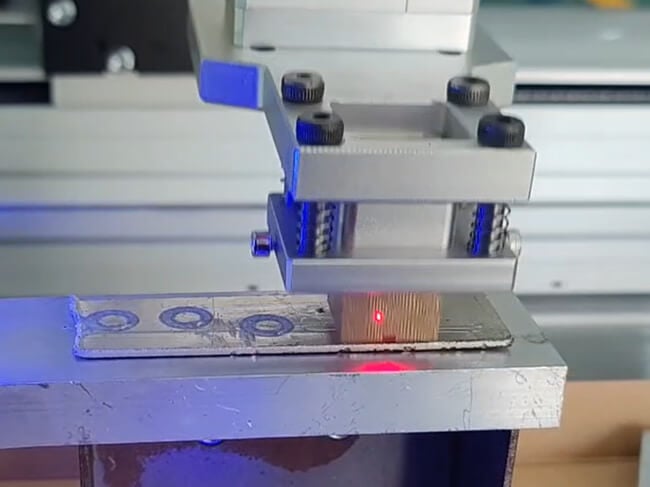
An automatic machine can apply the same programmed sequence to multiple components.
When combined with accurate fixtures, suitable sensors, and process monitoring, this approach can reduce variations caused by manual positioning.
Some advanced systems also support inspection and production data collection.
However, automation alone doesn’t eliminate defects. Incorrect settings, contaminated surfaces, poor component contact, and worn tooling can still affect the results.
Manufacturers should establish acceptable process windows and inspect representative weld samples before production.
Manual Laser Welder: Operator-Dependent Results
A manual laser welder provides direct control over the welding head.
Experienced operators can adapt their movements to different joint shapes and access conditions.
However, weld consistency may vary with travel speed, torch angle, focus position, and operator experience.
For this reason, manual laser welding requires proper training and clearly defined procedures when joint quality is critical.
Which Machine Produces Better Welds?
Neither machine automatically produces superior welds in every situation.
A dedicated automatic system can offer better repeatability for a validated battery welding process. A manual laser welder can produce excellent joints when the application suits the equipment and the operator follows an established procedure.
The final decision should come from sample welding, destructive or nondestructive inspection where appropriate, and electrical testing for battery connections.
6. Material Compatibility: Nickel, Copper, Aluminum, and Stainless Steel
Material compatibility is another major consideration.
Battery components often use nickel, copper, aluminum, steel, or combinations of different metals. Each material behaves differently during welding.
Electrical conductivity, reflectivity, melting characteristics, thickness, and surface condition can all influence the process.
Nickel Battery Tabs
Nickel tabs and nickel strips are common in battery pack assembly.
Resistance spot welding is a practical choice for many thin nickel connections because it can produce repeatable joints with relatively simple tooling.
Laser welding can also join nickel components when the laser parameters and joint design suit the application.
The best option depends on tab thickness, terminal material, weld geometry, and production requirements.
Copper Battery Tabs
Copper offers excellent electrical conductivity, but its high reflectivity and thermal conductivity can make laser welding challenging.
The laser source, wavelength, power delivery, focus, and process control must suit the copper application.
An automatic battery tab welder may provide a suitable solution if its welding technology and specifications support the required copper joints.
A manual laser welder may also work for selected copper components, but you should never assume compatibility based on the machine’s ability to weld other metals.
Aluminum Battery Tabs
Aluminum is lightweight and widely used in battery applications.
However, its oxide layer, thermal characteristics, and tendency to reflect certain laser wavelengths can affect weld formation.
Manufacturers should verify the laser source, joint design, material thickness, and process settings before selecting a manual or automatic laser system.
Stainless Steel Components
Stainless steel appears in battery housings, brackets, enclosures, and other fabricated parts.
A manual laser welder can be a useful choice for these general fabrication tasks.
A dedicated battery tab welder may also join suitable stainless steel components, depending on its design.
The key takeaway: Choose welding equipment based on the actual material combination and joint requirements, not just the material name.
7. Initial Investment and Operating Costs
Machine price matters, but the purchase cost is only one part of the financial decision.
A useful comparison includes the equipment, installation, tooling, labor, maintenance, consumables, training, quality inspection, and cost of rejected parts.
Automatic Battery Tab Welder Costs
The initial investment varies considerably.
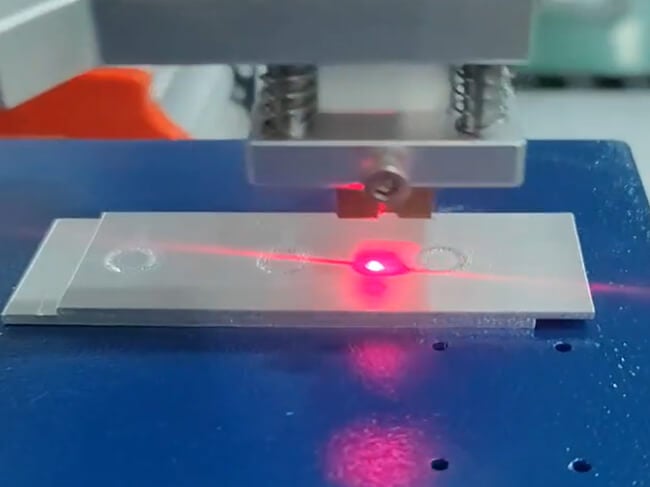
A basic automatic resistance spot welder may cost less than a sophisticated laser welding cell with vision systems, motion control, and production monitoring.
Potential costs include:
- Welding power supply.
- Automated positioning equipment.
- Dedicated fixtures.
- Sensors and inspection systems.
- Safety enclosures.
- Installation and integration.
- Maintenance and tooling replacement.
Some automatic systems also require product-specific fixtures or programming when the manufacturer introduces a new battery design.
Nevertheless, a suitable automated system can reduce labor per unit and improve production consistency over time.
Manual Laser Welder Costs
A manual laser welder may offer a lower entry cost than a highly customized automatic production cell, although prices vary widely.
The system may require less automation hardware, making it attractive for smaller workshops.
Operating costs can include:
- Laser source maintenance.
- Protective lens and nozzle replacement, where applicable.
- Shielding gas, if required.
- Welding wire, if the process uses filler material.
- Operator training.
- Laser safety equipment and installation.
- Inspection and rework.
Laser equipment also requires appropriate safety controls, including suitable protective enclosures or other measures based on the laser classification and operating environment.
Which Machine Offers Better Value?
An automatic system may offer better value when production volume is high and product designs remain stable.
A manual laser welder may provide better value when the business handles a wide variety of parts and doesn’t need continuous automated production.
To make a reliable decision, calculate the expected cost per accepted part rather than comparing purchase prices alone.
8. Flexibility: Dedicated Battery Welding vs General Metal Fabrication
Flexibility can make a substantial difference to smaller manufacturers.
Automatic Battery Tab Welder
A dedicated automatic system is often designed around specific component dimensions, weld locations, and production sequences.
This specialization can improve repeatability.
However, changing the product may require new fixtures, revised programs, or adjustments to the welding process.
Some advanced systems support multiple products, but their flexibility depends on the available motion range, tooling, and software.
Manual Laser Welder
A manual laser welder is generally more adaptable to different component shapes and joint locations.
An operator can guide the welding head along straight seams, corners, and other accessible joints, as long as the machine supports the application.
This versatility can benefit businesses that manufacture:
- Stainless steel products.
- Aluminum housings.
- Custom sheet metal components.
- Metal cabinets.
- Small industrial assemblies.
- Prototypes and customized products.
However, a manual system isn’t automatically suitable for every battery welding task.
Thin battery tabs, tightly packed cells, and sensitive internal components demand careful control of heat input and weld penetration.
Choose flexibility when your product range changes frequently. Choose specialization when repeatability and production throughput dominate your requirements.
9. Maintenance and Operator Requirements
Maintenance affects machine availability, production costs, and long-term reliability.
The work required depends on the welding technology and the machine’s design.
Maintaining an Automatic Battery Tab Welder
Resistance welding systems require attention to electrode condition, contact surfaces, pressure, and welding parameters.
Electrode wear can affect joint consistency, so maintenance schedules and inspection procedures are important.
Automatic laser systems have different requirements. These may include optical inspection, protective window replacement, alignment checks, cooling system maintenance, and servicing of the extraction system.
Manufacturers should follow the equipment supplier’s maintenance recommendations.
Maintaining a Manual Laser Welder
Manual laser welding systems also require routine care.
Depending on the model, maintenance may involve:
- Inspecting protective lenses.
- Cleaning accessible optical components per the manufacturer’s instructions.
- Checking cooling equipment.
- Inspecting cables and connectors.
- Maintaining the welding head.
- Checking gas delivery and wire feeding, where applicable.
Operators should receive training in equipment operation, routine inspection, and laser safety.
Which Machine Is Easier to Operate?
A manual laser welder may have a straightforward setup for general fabrication, but producing consistent welds still requires skill.
An automatic system may reduce the amount of manual welding skill needed during routine production. However, operators and technicians still need to understand setup, process validation, troubleshooting, and quality control.
The right question isn’t simply which machine is easier to use. It’s which machine fits your workforce, production process, and quality requirements.

10. Safety Considerations for Battery Tab Welding
Battery welding requires particular attention to safety because both the welding process and the battery itself can introduce hazards.
Laser welding presents risks from direct or reflected laser radiation, hot metal, fumes, and fire. Resistance welding also involves electrical energy, heat, and potential sparks.
Battery-related hazards depend on cell chemistry, condition, state of charge, and the specific operation.
Before choosing either machine, consider the following requirements.
Laser safety
Use a suitable laser safety enclosure or other controls appropriate to the equipment’s classification and operating conditions. Provide the required protective eyewear, interlocks, and operator training.
Heat management
Control energy input to prevent excessive heating of the battery cell and nearby materials.
Workpiece positioning
Secure the components to prevent movement during welding.
Fume extraction
Provide suitable extraction and ventilation based on the materials and process.
Fire protection
Assess ignition risk and implement appropriate fire prevention and emergency procedures.
Battery handling
Follow the battery manufacturer’s handling requirements and applicable safety procedures. Don’t weld damaged or compromised cells.
Quality inspection
Validate the welding process to ensure the connection meets the required electrical and mechanical specifications.
For battery applications, select a machine only after confirming it can achieve the required joint quality without unacceptable damage to the cell or surrounding components.
11. Which Machine Is Better for Small Businesses?
Small businesses often need to balance equipment costs, production flexibility, labor availability, and customer demand.
Neither machine is universally better.
Choose an Automatic Battery Tab Welder If:
- You produce battery packs regularly.
- Your products have standardized welding locations.
- You need repeatable weld quality.
- Production volume justifies automation.
- You want to reduce manual positioning.
- Your process benefits from programmed sequences and monitoring.
For example, a business assembling large batches of battery packs for power tools may benefit from a dedicated automatic system.
Choose a Manual Laser Welder If:
- You manufacture different metal products.
- Your production volume is low or moderate.
- You need flexibility across several compatible materials.
- You frequently work with custom parts.
- You want one welding system for multiple fabrication tasks.
- You have trained operators and suitable laser safety controls.
For example, a metal fabrication workshop producing stainless steel housings, aluminum brackets, and custom enclosures may find a manual laser welder more versatile.
What If You Manufacture Both Battery Packs and Metal Products?
In this situation, evaluate whether one machine can genuinely satisfy both applications.
A manual laser welder may handle certain battery components and general metal fabrication tasks, but it won’t necessarily replace a specialized battery tab welding system.
Likewise, an automatic battery tab welder may work well for battery assembly but may not suit the workshop’s other welding needs.
Testing representative parts before purchasing can help avoid an expensive mismatch.
12. How to Choose the Right Welding Machine
Before requesting quotations, define your production requirements.
Use the following checklist to compare equipment objectively.
1. Identify the Materials
List every material that needs welding, including nickel, copper, aluminum, stainless steel, or combinations of different metals.
2. Confirm Material Thickness
Specify the thickness of both workpieces, not just the battery tab.
The tab-to-terminal combination can significantly influence the welding process.
3. Define the Joint Geometry
Determine whether you need spot welds, overlapping joints, seams, or other configurations.
4. Set Your Production Target
Estimate the number of parts and weld points required per shift.
Include loading, positioning, inspection, and unloading in your cycle-time calculation.
5. Establish Quality Requirements
Define the acceptable weld strength, electrical resistance, penetration, and appearance.
Choose inspection methods appropriate to the application.
6. Evaluate Automation Requirements
Decide whether manual operation, programmable positioning, or a fully integrated production system makes the most sense.
7. Calculate the Total Cost
Include tooling, maintenance, training, labor, installation, consumables, and expected rework.
8. Request Sample Welding
Ask the supplier to test your actual materials and joint designs.
Inspect the results and, where appropriate, perform mechanical and electrical testing.
9. Verify Safety Requirements
Confirm that the proposed system includes or supports the necessary safety measures for the intended application.
10. Consider Future Production
Think about expected output growth, new product designs, and the potential need for automation.
A machine that meets today’s requirements may not be the most economical option if production changes significantly next year.
13. Frequently Asked Questions
Q1: Is an automatic battery tab welder better than a manual laser welder?
An automatic battery tab welder is often better for repetitive battery assembly because it improves production consistency and reduces manual positioning.
A manual laser welder is generally more flexible for varied metal fabrication tasks.
The best choice depends on the welding technology, materials, production volume, and required joint quality.
Q2: Can a manual laser welder weld battery tabs?
Yes, a manual laser welder can weld certain battery tabs when its specifications, materials, and joint geometry support the application.
However, you must validate the process to control penetration, heat input, and electrical joint quality.
Not every general-purpose laser welder is suitable for battery tab welding.
Q3: Is laser welding better than resistance spot welding for battery tabs?
Neither technology is best for every battery application.
Resistance spot welding is widely used for suitable thin nickel-tab connections. Laser welding offers flexibility in weld geometry and can accommodate a broader range of materials and thicknesses when properly configured.
The right method depends on the tab material, terminal design, thickness, production rate, and quality requirements.
Q4: Which machine is more cost-effective?
A dedicated automatic machine can be cost-effective for high-volume production, while a manual laser welder may suit businesses that handle varied jobs.
Compare total operating costs and cost per accepted part rather than looking at the initial purchase price alone.
Q5: Can one laser welder replace a dedicated battery tab welding machine?
Sometimes, but not always.
A manual laser welder may handle selected battery tab applications. However, a dedicated system may offer more suitable fixtures, positioning, process monitoring, or automated handling.
Manufacturers should validate the proposed solution using their actual battery components before replacing a dedicated production system.
Conclusion
Choosing between an automatic battery tab welder and a manual laser welder depends on production priorities.
An automatic battery tab welder is a strong option for manufacturers who need repeatable connections, consistent production cycles, and efficient battery assembly. Its suitability depends on the welding technology and the specific battery components being joined.
A manual laser welder offers greater flexibility for many general metal fabrication tasks. It can be a practical investment for workshops that manufacture different products and need direct control over the welding process.
Before making your decision, consider material compatibility, weld quality, production volume, operator skills, safety requirements, and total operating costs.
Most importantly, test the machine on your actual workpieces before purchasing it. A successful sample weld provides more useful evidence than a specification sheet alone.
With the right equipment and a validated welding process, you can improve production efficiency, control manufacturing costs, and build more reliable products.


